Hueber Energietechnik EWS 2026 v5.8
Borehole Heat Exchanger Simulation Program
The EWS program is a powerful simulation tool for borehole heat exchangers (BHE) and geothermal energy systems. It enables engineers, planners, and geothermal specialists to calculate inlet and outlet temperatures, heat extraction rates, and thermal performance for both individual boreholes and complete borehole fields.
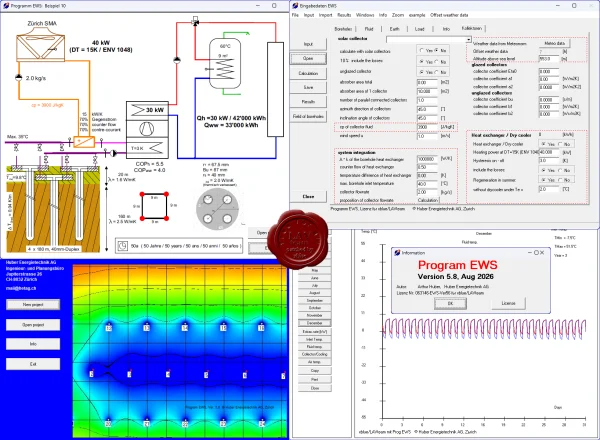
With hourly time-step calculations over simulation periods of up to 200 years, EWS can model the long-term thermal behavior of borehole heat exchanger systems and evaluate the major factors affecting geothermal heating and cooling performance.
The ground can be divided into up to 10 different geological layers, each with its own ground material and thermal properties. This allows users to create detailed models that accurately represent varying subsurface conditions.
Because EWS supports unsteady fluid flow calculations, the software can also simulate important processes such as system start-up, transient operation, and Thermal Response Tests (TRT). The program can additionally determine the required borehole length according to the Swiss standard SIA 384/6, making it a valuable tool for geothermal system design and borehole sizing.
Direct Cooling with Borehole Heat Exchangers
The full version of EWS also supports the simulation of direct cooling systems using borehole heat exchangers. Boreholes can be positioned in flexible and random arrangements directly on the graphical screen, allowing users to model complex geothermal borehole fields.
The software can simulate the hydraulic connection between the borehole heat exchanger system and a building's cooling system based on the return temperature. Applications include TABS (Thermally Activated Building Systems), chilled ceilings, and ventilation systems.
EWS can also handle complex ventilation schedules and dynamic operating conditions. Outdoor air temperatures can be imported from meteorological databases such as Meteonorm using hourly weather data, enabling detailed simulations of building cooling demand and geothermal heat exchanger performance.
Applications of EWS
The EWS borehole heat exchanger simulation program can be used for:
Geothermal heating and cooling system design
Borehole heat exchanger and borehole field simulation
Ground source heat pump system analysis
Long-term geothermal performance calculations
Thermal Response Tests (TRT)
Start-up and transient system simulations
Borehole length and sizing calculations according to SIA 384/6
Direct cooling system simulations
TABS and chilled ceiling applications
Ventilation and building cooling simulations
Complex borehole field configurations
Hourly meteorological and outdoor temperature simulations
EWS provides a comprehensive solution for analyzing the thermal and hydraulic performance of borehole heat exchangers, helping engineers and geothermal professionals optimize the design and long-term operation of ground-source heating and cooling systems.
17MB
Download
🔒 Upgrade
Borehole Heat Exchanger Simulation Program
The EWS program is a powerful simulation tool for borehole heat exchangers (BHE) and geothermal energy systems. It enables engineers, planners, and geothermal specialists to calculate inlet and outlet temperatures, heat extraction rates, and thermal performance for both individual boreholes and complete borehole fields.
With hourly time-step calculations over simulation periods of up to 200 years, EWS can model the long-term thermal behavior of borehole heat exchanger systems and evaluate the major factors affecting geothermal heating and cooling performance.
The ground can be divided into up to 10 different geological layers, each with its own ground material and thermal properties. This allows users to create detailed models that accurately represent varying subsurface conditions.
Because EWS supports unsteady fluid flow calculations, the software can also simulate important processes such as system start-up, transient operation, and Thermal Response Tests (TRT). The program can additionally determine the required borehole length according to the Swiss standard SIA 384/6, making it a valuable tool for geothermal system design and borehole sizing.
Direct Cooling with Borehole Heat Exchangers
The full version of EWS also supports the simulation of direct cooling systems using borehole heat exchangers. Boreholes can be positioned in flexible and random arrangements directly on the graphical screen, allowing users to model complex geothermal borehole fields.
The software can simulate the hydraulic connection between the borehole heat exchanger system and a building's cooling system based on the return temperature. Applications include TABS (Thermally Activated Building Systems), chilled ceilings, and ventilation systems.
EWS can also handle complex ventilation schedules and dynamic operating conditions. Outdoor air temperatures can be imported from meteorological databases such as Meteonorm using hourly weather data, enabling detailed simulations of building cooling demand and geothermal heat exchanger performance.
Applications of EWS
The EWS borehole heat exchanger simulation program can be used for:
Geothermal heating and cooling system design
Borehole heat exchanger and borehole field simulation
Ground source heat pump system analysis
Long-term geothermal performance calculations
Thermal Response Tests (TRT)
Start-up and transient system simulations
Borehole length and sizing calculations according to SIA 384/6
Direct cooling system simulations
TABS and chilled ceiling applications
Ventilation and building cooling simulations
Complex borehole field configurations
Hourly meteorological and outdoor temperature simulations
EWS provides a comprehensive solution for analyzing the thermal and hydraulic performance of borehole heat exchangers, helping engineers and geothermal professionals optimize the design and long-term operation of ground-source heating and cooling systems.
17MB
Download
🔒 Upgrade